

Unleashing the Beast: A Deep Dive into Guerrilla Marketing
Introduction: Debunking the Myth
What comes to your mind when you hear the term “guerrilla”? It appears to be quite intense, right? Initially, it evokes visions of insurgency, jungle warfare, and perhaps even violence. Then comes the word “marketing” suffixed to it. This combination makes people wonder: what could this phrase possibly mean? Will it be associated with aggressive competition or unhealthy competitive strategies? NO! Let’s set the record straight. Guerrilla marketing is not an aggressive mode of communication in the traditional sense. In reality, it’s a highly unusual or unconventional type of marketing that boosts brand recognition among big audiences without interfering with them directly. It is about surprise, delight, and creativity rather than force.
The Origin of the Term “Guerrilla Marketing”
To truly understand this concept, we must look at its roots. A marketing consultant named Jay Conrad Levinson invented the phrase “guerrilla marketing” in his seminal book “Guerrilla Advertising” back in 1984. He was inspired by guerilla warfare, a strategy in which small groups of soldiers used unusual, surprise tactics to defeat bigger, better-equipped armies. Levinson applied this military logic to the business world.
Similarly, Levinson thought that tiny businesses could outperform larger competitors through innovative marketing methods rather than massive budgets. Since then, the phrase has evolved to be used widely in the marketing profession to denote creative and unique marketing strategies that punch above their weight class. It is the classic story of David versus Goliath, retold for the modern marketplace.
Exploring the Types of Guerrilla Marketing
Guerrilla marketing is not a one-size-fits-all approach; rather, it manifests in various forms depending on the location and the level of interaction required. Let’s explore the four primary types that marketers use to captivate their audiences.
Types of Guerrilla Marketing:
1. Outdoor Guerrilla Marketing
First on the list is Outdoor Guerrilla Marketing. This style of marketing incorporates something new into pre-existing urban landscapes, such as affixing something removable to a statue or displaying temporary artwork on sidewalks and streets. It alters the environment in a way that causes passersby to do a double-take.
For example, imagine you’re going down the street, minding your own business, when you come upon a statue wearing a weird headgear. That’s guerrilla marketing on the street! It takes something already there in the surroundings and adds a creative twist to it in order to catch your attention. The goal is to integrate the brand into the daily life of the city in a way that feels organic yet surprising.
2. Indoor Guerrilla Marketing
Next, we have Indoor Guerrilla Marketing. As the name suggests, this type occurs indoors in places such as railway stations, shops, and university campus buildings. It leverages enclosed spaces where people are often waiting or passing through, creating a captive audience for the spectacle.
For instance, imagine you’re in an airport, waiting for your flight, when all of a sudden, a bunch of pilots and airline staff dressed in superhero costumes begins acting out a scene in front of you. Before you know it, they unveil the brand they’re promoting. That’s guerrilla marketing at its finest! It’s all about giving the public an exceptional experience while interacting with the brand in a setting where they least expect it.
3. Event Ambush Guerrilla Marketing
Moving on, we encounter Event Ambush Guerrilla Marketing. This style of marketing uses the audience of an ongoing event, such as a concert or athletic event, to promote a product or service in a prominent fashion. This is usually done without the approval of the event sponsors, making it a risky but potentially high-reward strategy.
For example, imagine you’re at a sporting event, and you observe a group of individuals handing out free samples of a new energy drink that you’ve never heard of before. That’s guerrilla marketing at an event! It uses the audience of a huge event to promote a product or service in a visible way. While it operates in a legal grey area, the visibility it generates can be massive.
4. Experiential Guerrilla Marketing
Finally, there is Experiential Guerrilla Marketing. This is essentially a blend of the previous types, but executed in a way that requires the public to interact with the brand physically. It often involves creating an immersive experience that people will remember and share with others.
Imagine strolling into a university building and coming upon a massive, interactive art exhibit marketing a new smartphone. That’s guerrilla marketing in action! It is comparable to outdoor guerrilla marketing, but it focuses heavily on participation. By touching, moving, or engaging with the installation, the consumer becomes part of the advertisement itself.
Weighing the Risks and Rewards: Pros and Cons
Like any marketing strategy, guerrilla marketing has its upsides and downsides. It is crucial to weigh these before launching a campaign.
The Advantages
Guerrilla marketing has distinct advantages, primarily because it employs an unconventional and original strategy. Consequently, this makes it more memorable and creates a lasting impact in people’s minds. Unlike standard advertising tactics, which can be ignored, guerrilla marketing demands attention. Furthermore, guerrilla marketing can be carried out on a shoestring budget, making it an appealing alternative for small firms and startups that cannot afford prime time TV slots. Such initiatives attract the attention of passers-by and inspire them to join by generating dynamic and compelling experiences.
The Disadvantages
On the flip side, there are plenty of fantastic instances of guerrilla marketing initiatives out there, as well as some epic fails too. One of the significant disadvantages of guerrilla marketing is the potential for Backlash. Because guerrilla marketing frequently employs unique and sometimes contentious approaches, there is a danger of offending or alienating potential clients. If a stunt is misinterpreted or seen as intrusive, it can damage the brand’s reputation.
None-the-less, if executed in the right manner, you win hearts and gain unsolicited promotions at a much cheaper cost! The key is to strike a balance between being surprising and being respectful.
Creative Inspiration: 6 Successful Guerrilla Marketing Campaigns
Are you now ready to be inspired by some of the most creative and successful guerrilla marketing concepts ever? These 6 campaigns demonstrate that thinking outside the box and coming up with something completely unique is the greatest approach to creating an impact. But keep in mind that, while imitation is the highest form of flattery, it will not lead to success in guerrilla marketing because it demands “uniqueness”! So, take a seat and prepare to be astonished by our top six picks, in no particular order.
1. McDonald’s – Fries That Cross Your Mind
In 2017, McDonald’s used guerrilla marketing to improve their brand in Sydney, Australia. They painted a crosswalk to resemble a package of fries, which drew pedestrian attention and went popular on social media. This innovative strategy raised brand awareness in a fun and engaging way. It turned a mundane safety feature into a playful branding moment, proving that sometimes the simplest ideas are the most effective.

2. Jacquemus – Buses Transformed into Stylish Bambino Bags
With a compelling video on their Instagram feed, the fashion company Jacquemus caused a sensation in the fashion and marketing worlds. The film featured gigantic Jacquemus Le Bambino bags on wheels that were skillfully constructed to look like buses as they travelled through the streets of Paris. These one-of-a-kind cars transported passengers inside, creating a spectacle that drew the attention of passersby. The crammed buses made quite an impression and became a topic of discussion for both fashion and marketing experts. It was a brilliant fusion of functionality and high fashion.

3. Kit Kat – Have A Break, Have A Seat
In Malaysia, Kit Kat used creative marketing to create a bench that resembled their popular chocolate bar. The bench could be broken apart into individual pieces, much like a Kit Kat bar, providing an interactive experience for shoppers. This excellent strategy not only drew passers-by’s attention but also generated a lasting brand experience. People found this to be a very interesting move by the brand, thus leaving a buzz in the market. It perfectly embodied their slogan, “Have a break, have a Kit Kat.”

4. Faber-Castell – Unleash Your Imagination with Every Stroke
Faber-Castell launched a one-of-a-kind marketing campaign in Singapore to highlight their goods and company values. They painted a girl on the side of a building, with her pencils colouring the sky. This innovative method brought attention not only to the brand’s values of creativity and imagination but also to the items themselves. The sheer scale of the artwork mirrored the limitless potential of their art supplies, inspiring everyone who walked past.

5. Gold Toe – A Fashion Statement Even Bulls Can’t Resist!
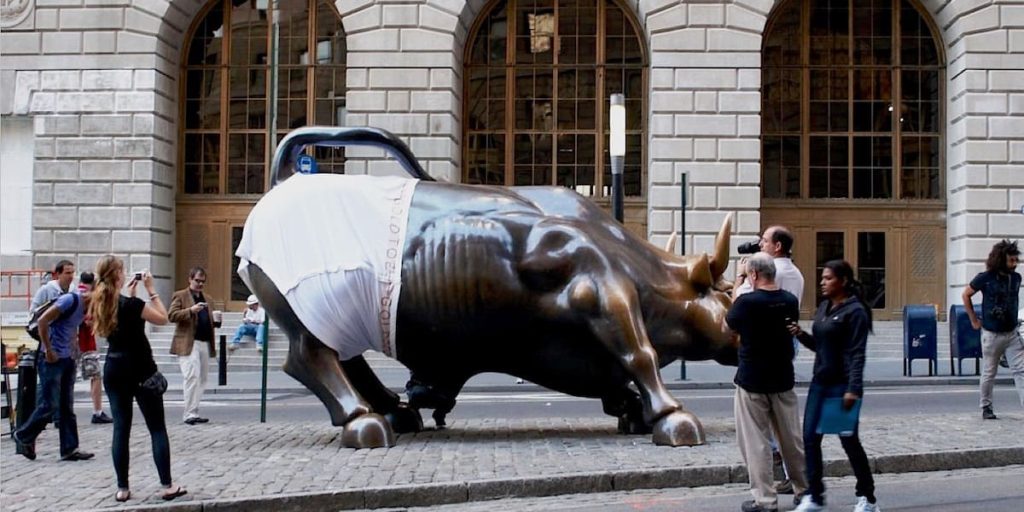
Gold Toe, a brand specializing in socks and underwear, used humor to promote their products. They placed a statue of a bull wearing their underwear in New York City’s financial district, an unexpected and amusing sight that caught the attention of pedestrians and drew attention to the brand. People started clicking pictures with the bull and posted it on social media platforms, and thus Gold Toe earned some unsolicited promotion. It was a bold, cheeky move that paid off in visibility.
6. Sprite – Refreshment That Will Wash Away Your Worries
Last but not least, to promote their refreshing qualities, Sprite created a shower space on a beach in Brazil designed to look like a giant Sprite bottle. Beachgoers could rinse off the saltwater and sand while associating the brand with refreshment. This creative approach not only caught the attention of beachgoers but also created a lasting impression and positive brand association. It provided actual utility to the consumer while reinforcing the product’s core benefit: refreshment.
